A product brochure for a customs knowledge assistant
Selling a conversational assistant to an audience professionally trained to distrust confident answers.
Product brochure for a retrieval-augmented assistant, co-funded programme
The document is published in full underneath, and it is the client’s.
- Product
- Retrieval-augmented knowledge assistant for customs and trade regulation
- Reader
- Customs authorities, authorised economic operators, trade finance teams
- Constraint
- A regulated reader who has to be able to check the answer
The hard part of this brochure was not explaining what the product does. It was writing for a reader whose entire professional instinct is to distrust a confident answer with no citation behind it.
So the argument never leads on capability. It leads on the shape of the current day: manual search across databases, websites and documents; hours spent filtering; accuracy that depends on how good the searcher’s keywords happen to be; and updates that arrive by newsletter, if they arrive. Every claim about the assistant is then written as the same row on the other side of that comparison, which lets a sceptical reader audit the promise line by line instead of taking it whole.
Where the writing had to be careful
Two places. The first is interpretation. Saying an assistant interprets regulation is a claim a compliance officer will not accept and should not. The section was rewritten so the assistant explains regulation in plain language for a practitioner to apply, and the practitioner stays the one applying it. The retrieval framework and the human in the loop are named as architecture, not as reassurance.
The second is the cost case. It is built from stated parameters, hours per analyst per week and cost per review, so it reads as arithmetic and not as a promise. A reader who disputes the hours can substitute their own and still follow the page.
Eliminate the need to navigate complex systems. Everything in one place, with conversational simplicity.
The pilot section is deliberately unglamorous: kick-off, scope, set-up, training, testing, evaluation, with a duration against each. In a category where the buyer’s real fear is a project that never ends, a short honest timeline is more persuasive than another benefit.
Produced under a co-funded programme and published here as it was handed out. The write-up above is about the decisions in it; the document speaks for the product.
The brochure
The document itself. The portfolio map, the challenges the product answers, the manual process set against the assisted one row by row, the cost drivers with their arithmetic shown, the retrieval architecture and the pilot plan with a duration against every stage.
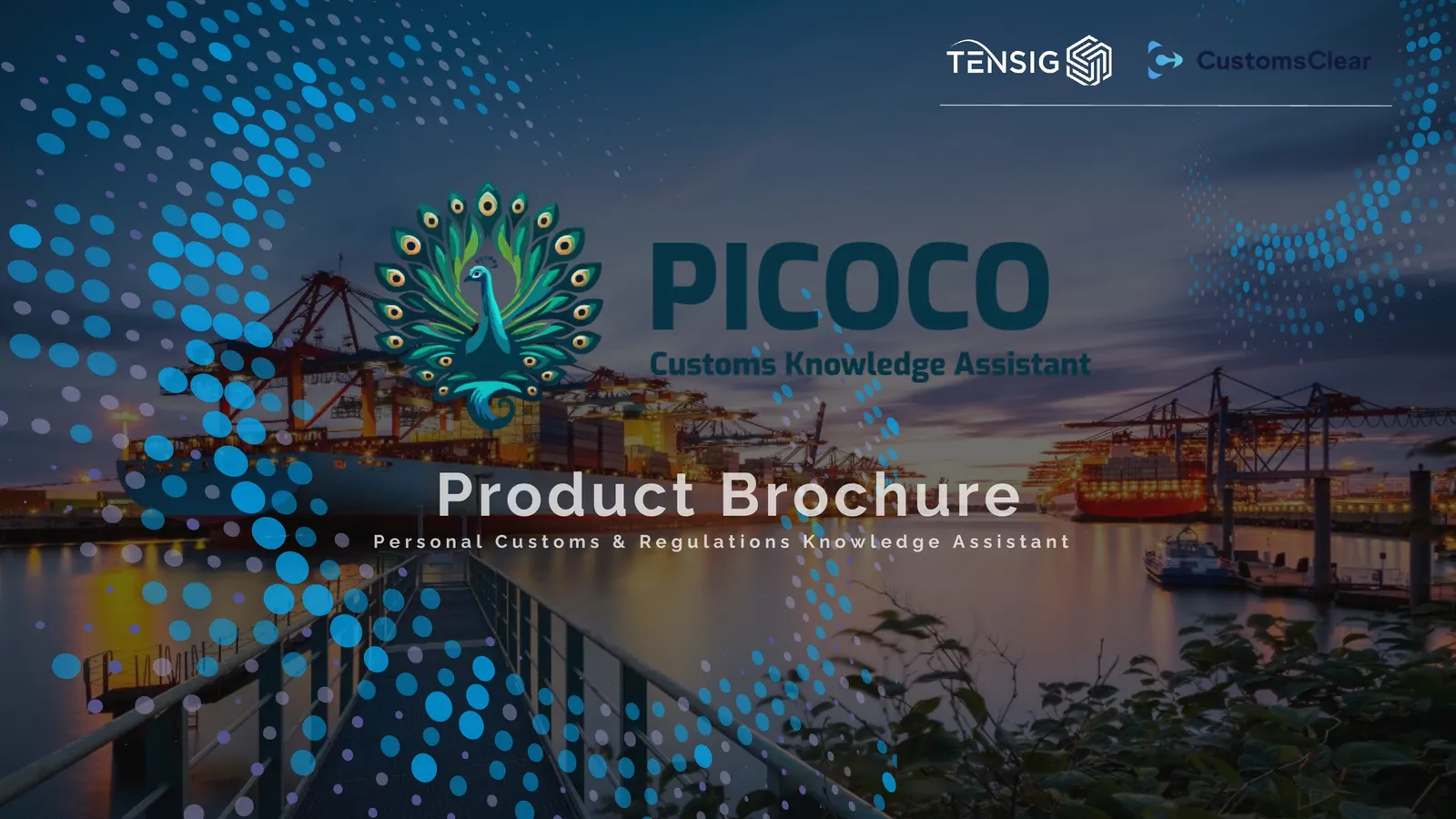
This document is a wide-format brochure. On a small screen it reads better opened on its own.