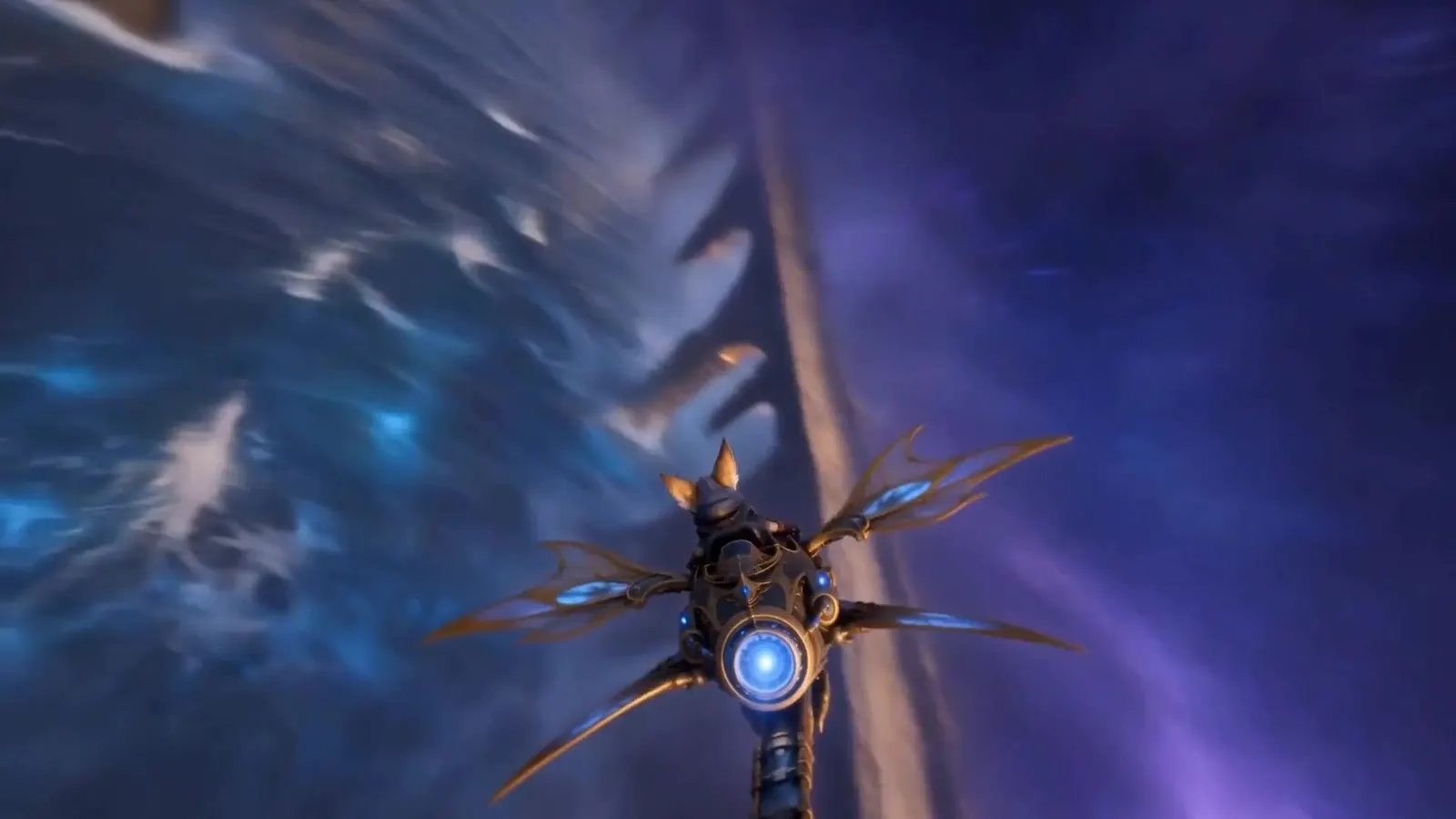
Original short 0:30
Skyrunner
A small pilot takes the line through the city that nobody bigger can fly.
A pocket-sized scout flies her own glider through a floating spire city, threads the arcane rings and the waterfalls at full speed, drops onto a terrace held by armoured enforcers, and gets off the machine already fighting.
- Runtime
- 0:30
- Format
- 1920 x 1080 / 30 fps / 16:9
- Blocks
- 6 generation blocks, chase camera
- Video model
- Seedance 2.0
- Design
- ChatGPT Image 2
- Control layer
- Claude x Higgsfield MCP
- Skills
- tig-scene-engine, tig-acting-task, cinedance
The film
The spine was beaten out with the tig-scene-engine skill before a single frame was generated. A short cut still needs a chain, otherwise it is only a reel of pretty motion.
- Goal
- Reach the terrace and take back what is being loaded there.
- Obstacle
- A city built at the wrong scale for her, then a unit of enforcers who are ten times her weight and hold the ground she needs.
- Tactic
- Fly the route nobody larger can fly. On foot, stay inside their reach where a heavy blade cannot land.
- Reversal
- The approach she planned as a quiet one ends in a hard skid in open view. The glider stops hiding her and starts announcing her.
- Value shift
- She reads as a courier, small and quick. By the last frame she reads as someone who came for this fight and knew the odds.
The route was drawn by hand before a single frame was generated. Everything after that is just holding the line.
- Runtime
- 0:30
- Master
- 1920 x 1080, 30 fps, H.264
- Sound
- Model audio, layered and mixed in the edit
- Dialogue
- None. Flight noise and impact carry it
- Status
- Complete. Original characters and world
Beat map
6 generation blocks, cut internally where the model was asked for a hard cut.
Cast and world
The pilot and her machine were designed on one sheet so that the rider and the glider would never drift apart, with a turnaround, detail crops, a specification block and three flight states. The enforcers got their own sheet at true scale, since the whole ground fight depends on the size gap being obvious. The city was painted as a single wide plate and used for geography, materials and light direction.
-
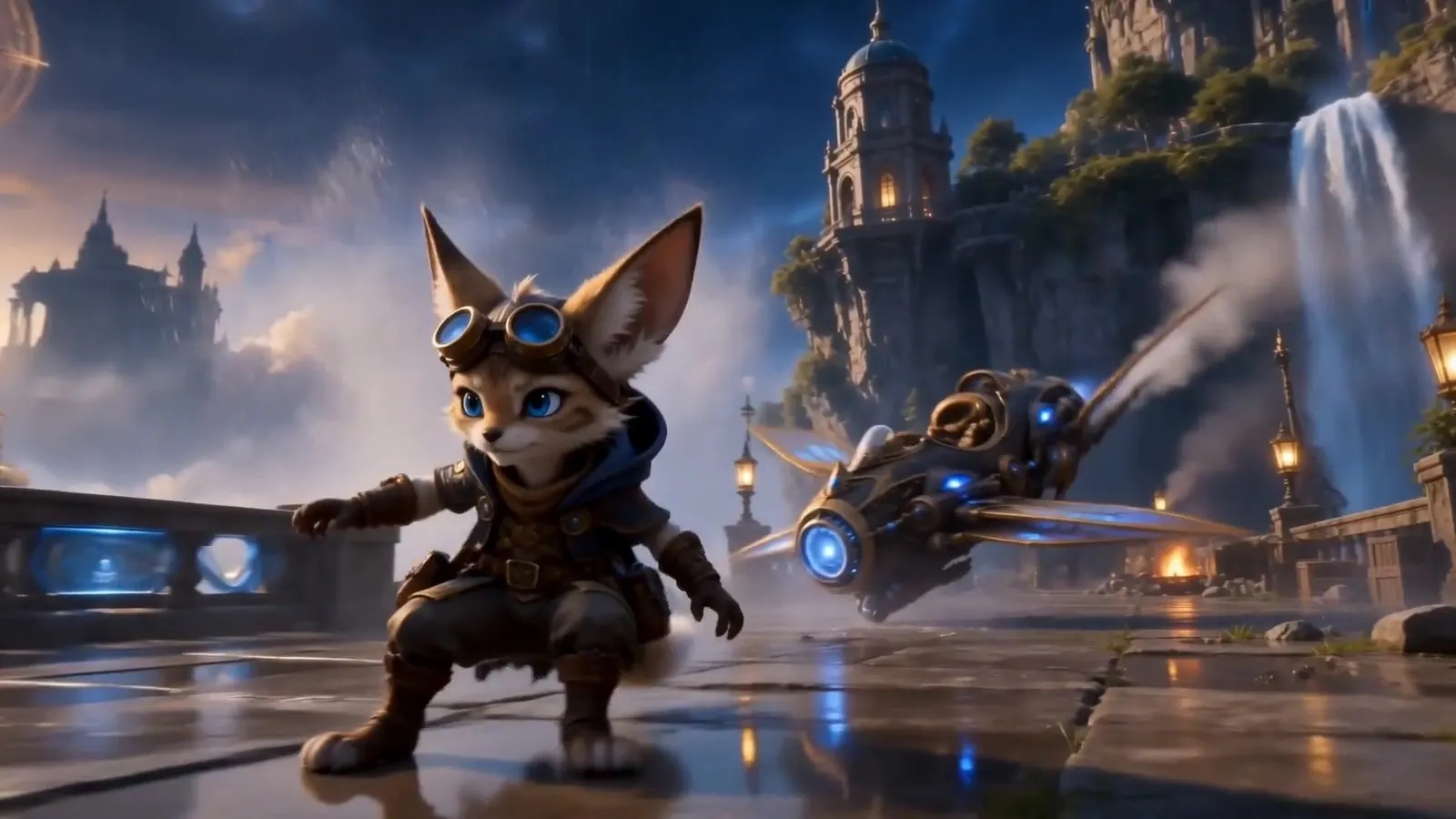
@lyrian_v1 + @skyrunner_v1
Pilot and arcane-steam glider on one sheet
-
@enforcer_v1
Elite shock trooper, 210 to 220cm
-
@spires_v1
The floating city, used for geography, materials and light direction
One tag per identity. The city plate never dictates framing, only geography.
The route
The one step that made the flight read as a flight, and the only stage of the whole build that left the screen.
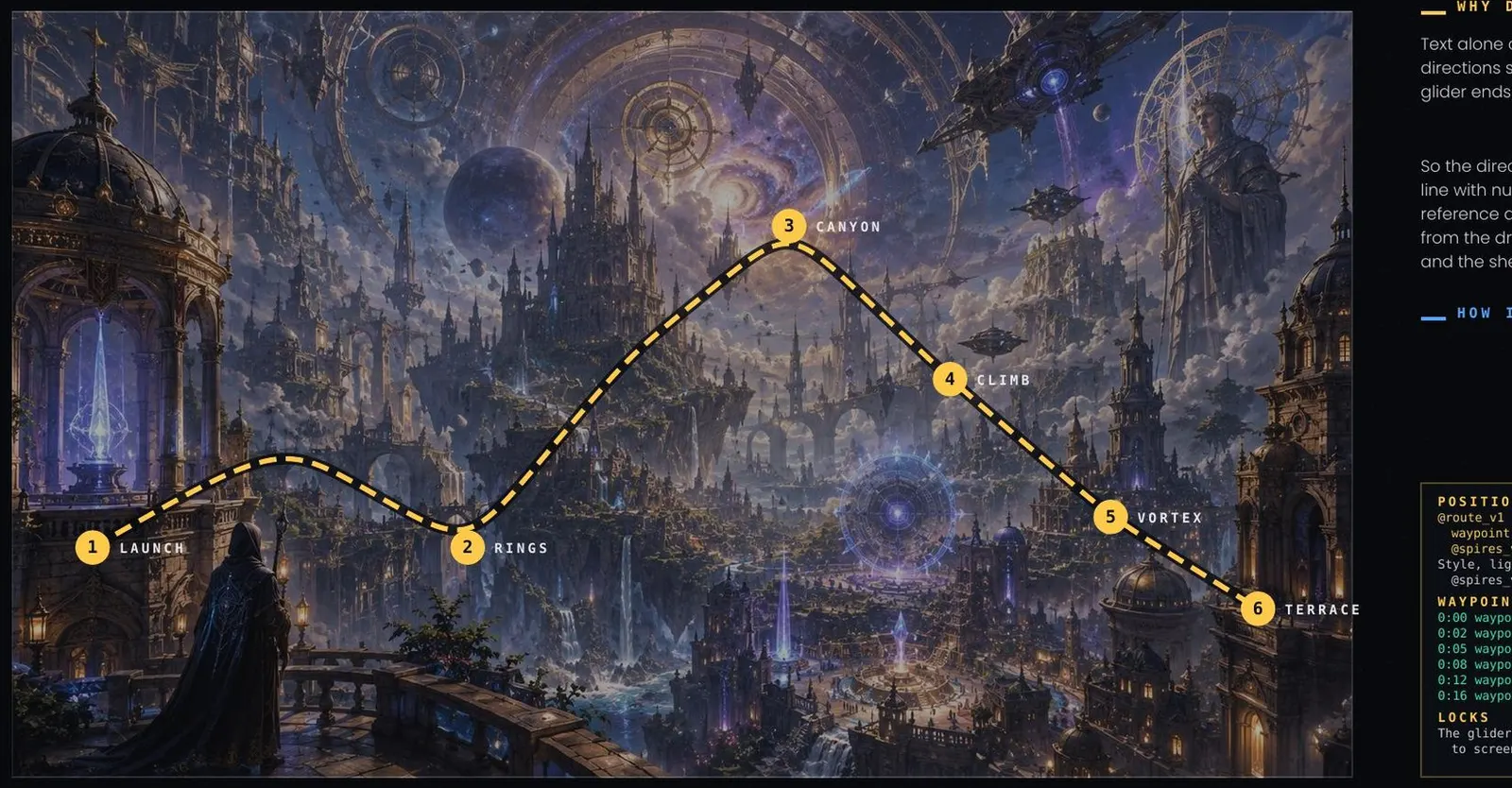
Why draw on the plate
Text alone cannot hold a route through a city with no street names. Written directions send the model looking for landmarks it has to invent, and the glider ends up wandering, reversing or teleporting between blocks.
So the direction of travel was drawn by hand over the location art as a single line with numbered waypoints, then handed to the model as a position reference alongside the plate and the character sheet. Geometry comes from the drawing. Every visual quality of the shot keeps coming from the plate and the sheets.
How it is written into the prompt
@route_v1 - POSITION REFERENCE ONLY. Read it for the direction of travel, the waypoint order and the height of the glider above the architecture inside @spires_v1.

Style, light, colour, materials and every surface in the shot come from @spires_v1 and the character references.
Waypoint order
- 1 Launch 0:00 launch below the observation balcony.
- 2 Rings 0:02 through the outer ring, screen-left to screen-right.
- 3 Canyon 0:05 down into the canyon, wing 2 metres off the wall.
- 4 Climb 0:08 climb through the cloud shelf.
- 5 Vortex 0:12 silhouette pass across the spiral in the sky.
- 6 Terrace 0:16 descend to the terrace and land.
Locks
- The glider never reverses direction between waypoints.
- Travel stays screen-left to screen-right for the whole sequence.
Five blocks of flight that cut together as one continuous run, with the city passing in the same direction every time and the machine holding its altitude logic from the first frame to the landing.
Pipeline
From beat sheet to graded cut, inside one chat window.
-
01
STORY ENGINE
tig-scene-engine
Thirty seconds beaten into six blocks, with the reversal placed on the landing so that the flight is setup and the terrace is payoff.
-
02
DESIGN SHEETS
ChatGPT Image 2
Pilot and glider on one sheet, enforcers at true scale on another, the city as a single wide plate. Palette and materials fixed at this stage.
-
03
ROUTE DRAWING
Hand-drawn over the plate
The flight path drawn directly onto the city art with numbered waypoints, then used as a position reference. Geometry only, no style.
-
04
REFERENCE LOCK
Higgsfield library
One tag per identity, one for the city, one for the route. The route reference is attached last so the painted plate wins the style vote.
-
05
SHOT DESIGN
cinedance
Every block written as an engineering document: first frame, blocking, lens, timed action, physics, lighting, audio. Chase-camera distance stated in metres.
-
06
PERFORMANCE
tig-acting-task
The pilot is given something to do with her eyes at every beat: reading the gap, checking the wing, measuring the enforcer. Nothing is played as expression.
-
07
GENERATION
Seedance 2.0 via Claude x Higgsfield MCP
Batches fired from chat, jobs polled in the same thread, candidates returned inline. The route reference travels with every flight block.
-
08
SELECTION
Review pass
Blocks judged on direction of travel, wing geometry, rider scale and light continuity. Anything that flipped the travel direction was dropped on sight.
-
09
FINISH
Grade and sound
Warm gold held against the cold blue of the core, speed ramps on two turns, wind and impact laid under the flight.
THE ROUTE DRAWING IS THE ONLY STAGE THAT LEFT THE SCREEN. EVERYTHING ELSE RAN IN ONE THREAD.
The stack
Four tools, three custom skills, one operator.
-
Seedance 2.0
Video model
Image-to-video with native sound. Chosen here for sustained camera motion: the flight blocks hold a chase position for five seconds at a time without the frame falling apart.
-
ChatGPT Image 2
Design
Pilot and glider sheet, enforcer sheet, city plate. Held a painterly finish across every pass, which is what the video model reads back as a style vote.
-
Claude x Higgsfield MCP
Control layer
Prompts written, batched, submitted, polled and reviewed in one conversation, with the reference library addressed by tag.
-
Edit and grade
Finish
Assembly on motion, two speed ramps, grade and sound layup.
Custom Claude skills
-
tig-scene-engine
Structure
Goal, obstacle, tactic, reversal, value shift, applied with bespoke definitions. Used to place the reversal on the landing instead of somewhere in the air.
-
tig-acting-task
Performance
Acting written as an invested tactic. A small animal-featured character reads as a person only when the eyes are given work, so every ground beat states what she is reading.
-
cinedance
Prompt direction
Turns a beat into a production-ready Seedance prompt: blocking, optics, timing, physics, lighting locks, audio. Chase-camera work lives or dies on the distance and height being written down.
Speed is written, not wished for. Metres, seconds and one direction of travel.
Shot sheets
One block per generation, each with the still it produced and the prompt that made it, as written for Seedance 2.0 and built with the cinedance skill. Every prompt is here in full.
A Launch 0:00 - 0:05
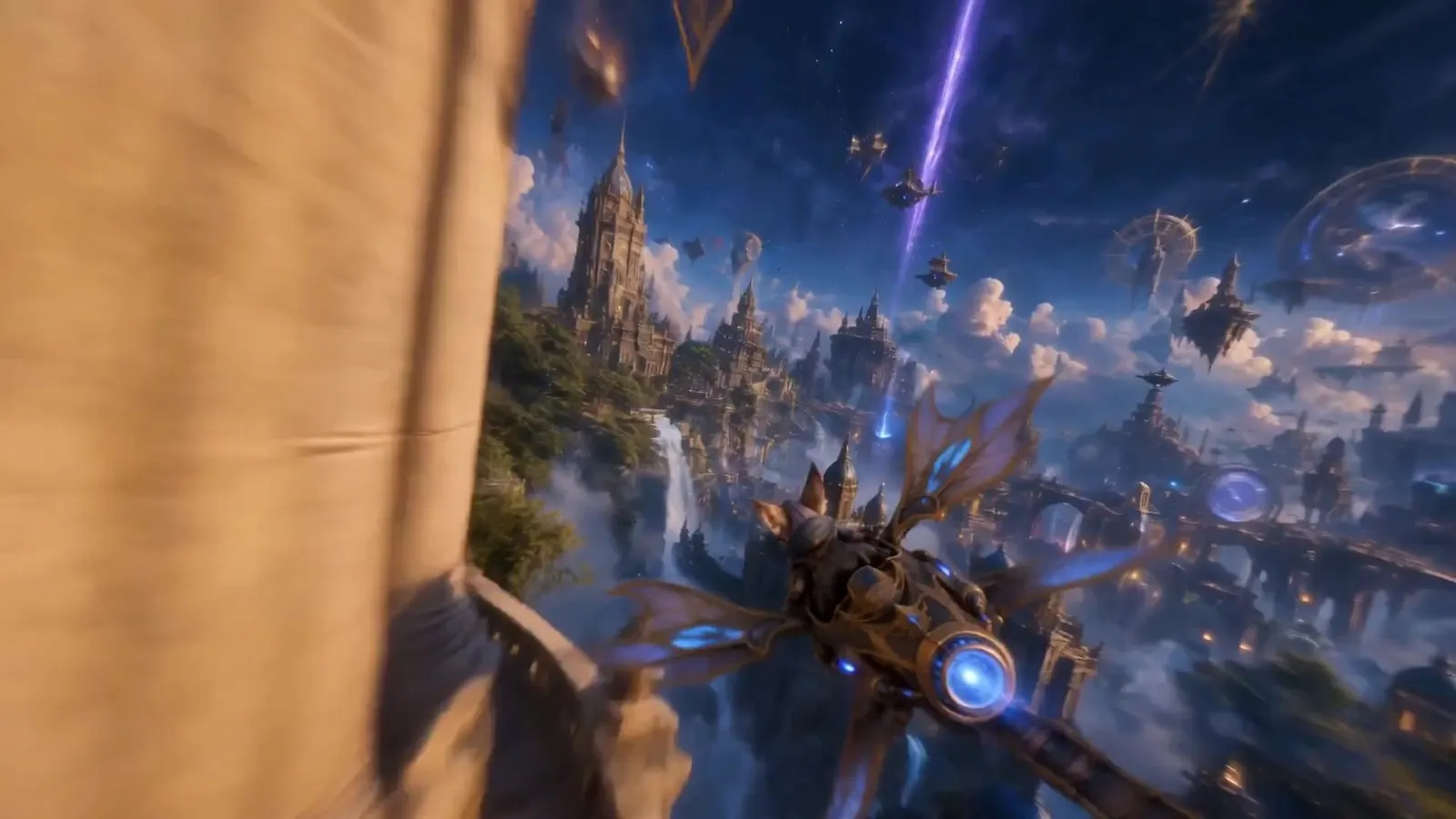
Opening block. The city is established and left behind inside five seconds, so the film never stops to admire itself.
SCENE CONTEXT
A small pilot drops her glider off a high balcony and dives into a floating spire city at speed.

ACTIVE REFERENCES
@lyrian_v1: 92cm fennec-featured scout, brass goggles on the forehead, blue-grey coat and leather harness, seated forward on the glider with both hands on the grips. 100% matches the reference.
@skyrunner_v1: 1.8m arcane-steam glider, brass frame, blue stained-glass wings, single blue core at the nose. 100% matches the reference.
@spires_v1: floating city of pale spires, waterfalls, arcane rings and cloud shelves under a violet sky.
@route_v1: position reference for direction of travel only.

LOCATION MAP
Camera starts above and behind the balcony, facing out over the city. The cathedral tower stands screen-right in the midground. Cloud sits below the balcony line. Light comes from the upper left.

FIRST FRAME AND SPATIAL BLOCKING
Frame opens on the city with @skyrunner_v1 already entering from the lower left. Travel runs screen-left to screen-right for the whole block. The camera holds 4 metres behind the tail and 1 metre above it.

OPTICS
18mm chase position. The wide field keeps both wings inside frame and lets the architecture stretch past at the edges.

CAMERA
Locked chase. The camera never overtakes and never falls behind. Roll follows the glider, horizon stays free to tilt.

ACTION TIMING
0:00 to 0:02 The glider drops past the balcony and the tower, wings level.
0:02 to 0:04 It banks left around the tower base, then rights itself.
0:04 to 0:05 It accelerates into open air above the cloud shelf.

PHYSICS
Wings hold their shape under load. Cloud tears past at the same speed as the architecture. The rider leans into the bank before the machine turns.

LIGHTING
Warm sun from the upper left, cold blue from the core at the nose, deep shade inside the canyon walls.

AUDIO
Wind, a low arcane hum, no music.

POSITIVE CONSTRAINTS
One glider, one rider. Direction of travel stays constant. Wings stay attached and stay blue.
B Ring Run 0:05 - 0:10
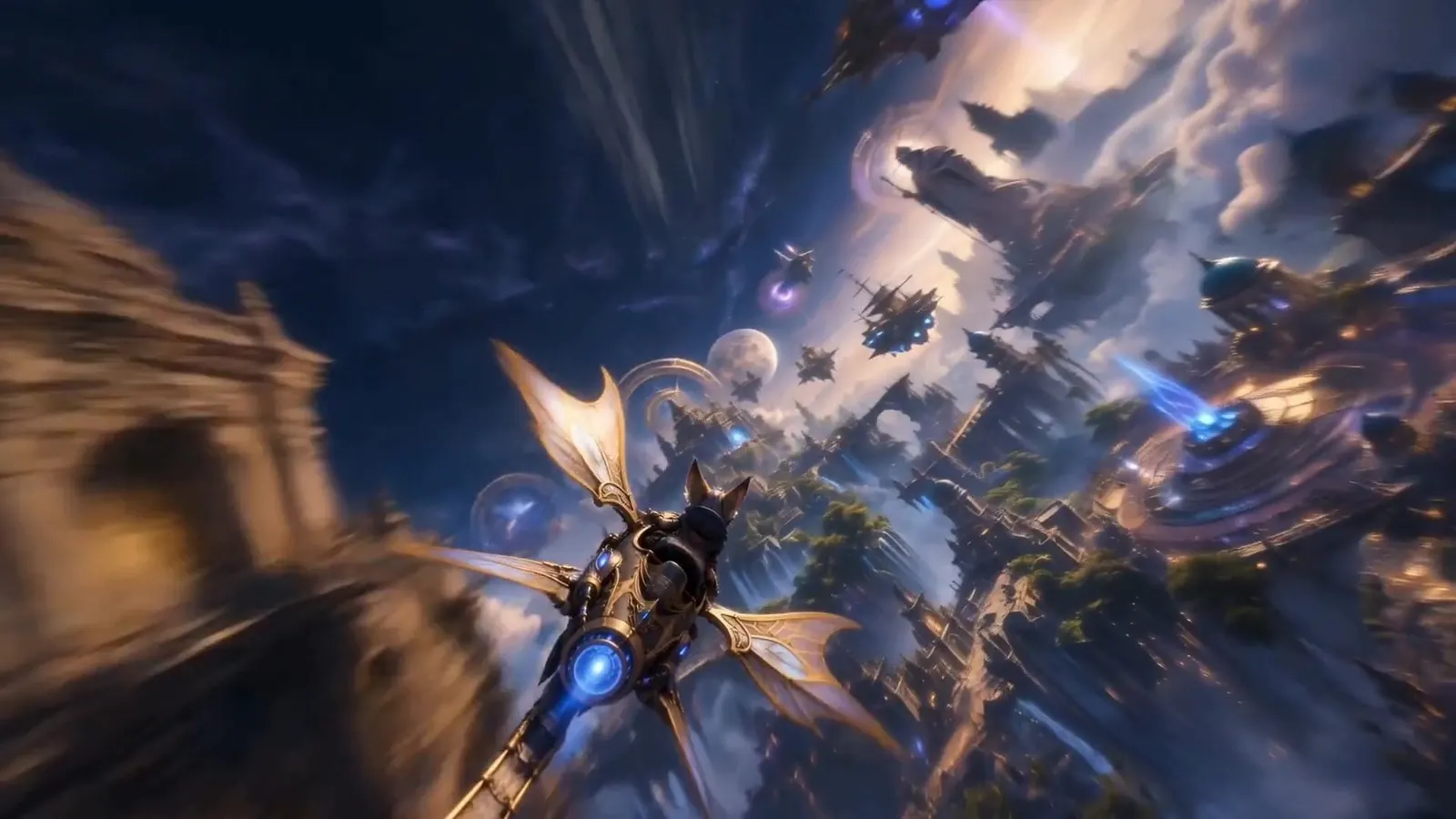
Skill on display. The rings give the audience a measure of how tight the flying is.
SCENE CONTEXT
The glider threads a series of floating arcane rings and stone bridges without slowing down.

ACTIVE REFERENCES
@lyrian_v1: pilot low over the frame, head up, both hands on the grips. 100% matches the reference.
@skyrunner_v1: glider at full speed, core burning blue.
@spires_v1: rings, bridges and towers of the floating city.
@route_v1: position reference for direction of travel only.

FIRST FRAME AND SPATIAL BLOCKING
Open with the glider already in frame at centre, first ring 30 metres ahead and slightly screen-right. Three more rings sit beyond it at increasing distance. The camera holds the chase position behind and above.

OPTICS
16mm. The very wide field exaggerates the closing speed on each ring and keeps the far city readable.

CAMERA
Chase, with a small lag on each turn so the glider leads the frame and the camera catches up. No cuts inside the block.

ACTION TIMING
0:00 to 0:02 Straight run at the first ring, wings level, passing through the centre.
0:02 to 0:03 Hard roll to the right through a narrow bridge span.
0:03 to 0:05 A climbing turn back to the left, second and third rings passing close to the wingtips.

ACTING TASK
She is reading the gap, not enjoying the view. Eyes go to the next opening before the current one is cleared, and the head turns to hold it through the roll. Hands adjust in small corrections, never in big theatrical pulls.

PHYSICS
The machine banks before it turns. Ring light passes across the wings as a moving reflection. Air disturbance trails behind the wingtips.

LIGHTING
Ring glow throws blue across the underside of the wings on each pass. Warm ambient stays on the top surfaces.

AUDIO
Wind, ring resonance on each pass, no music.

POSITIVE CONSTRAINTS
The glider passes through the centre of every ring. Travel direction holds. No second aircraft enters frame.
C The Canyon 0:10 - 0:16
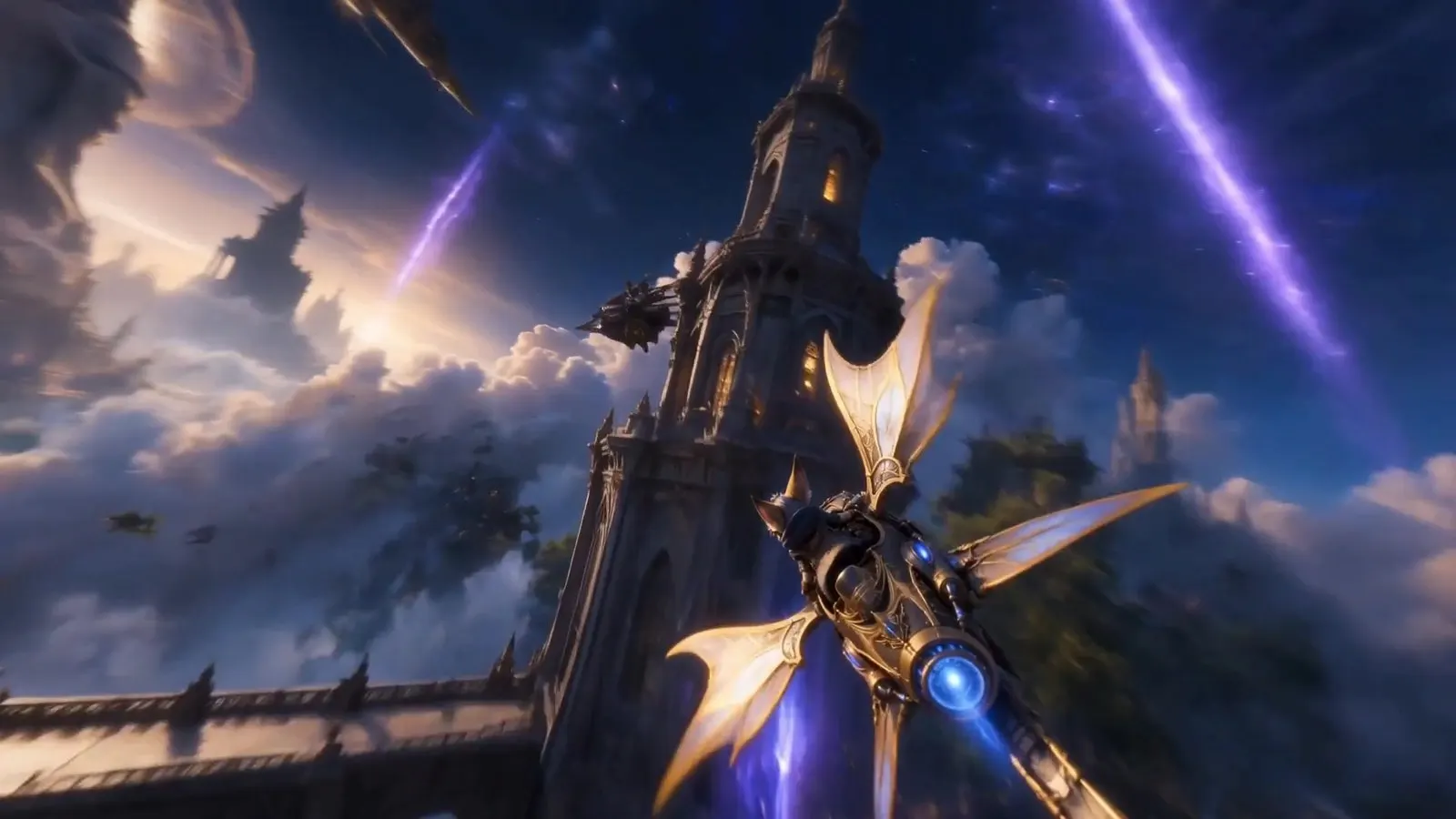
The block that sells the scale of the city, flown low enough that the walls do the work.
SCENE CONTEXT
The glider drops into a canyon between two districts, runs low past waterfalls and balconies, then climbs out through the cloud shelf.

ACTIVE REFERENCES
@lyrian_v1: pilot pressed low to the frame for the dive. 100% matches the reference.
@skyrunner_v1: glider, wings angled for the descent.
@spires_v1: canyon walls, waterfalls, hanging gardens, cloud shelf above.
@route_v1: position reference for direction of travel only.

FIRST FRAME AND SPATIAL BLOCKING
Open inside the canyon with walls filling screen-left and screen-right and the glider centred. The near wall stays within 3 metres of the left wingtip for the first three seconds. Waterfall crosses the path at the midpoint.

OPTICS
16mm on the descent for speed, 24mm on the climb so the cloud layer reads as depth instead of fog.

CAMERA
Chase position, dropping with the glider. On the climb the camera falls slightly behind and looks up, so the machine gains height inside the frame.

ACTION TIMING
0:00 to 0:02 Steep descent between the walls, spray thrown off the waterfall as it passes.
0:02 to 0:04 Low run past lit balconies, wing 2 metres off the stone.
0:04 to 0:06 Pitch up into the cloud shelf, cloud closing over the camera.

PHYSICS
Water spray hits the wings and streams backwards. The machine loses a little speed in the climb and gains it in the dive. Cloud reacts to the wings passing through it.

LIGHTING
Shadow inside the canyon with warm light on the upper rim, then flat bright diffusion inside the cloud.

AUDIO
Wind rising with speed, water, muffled air inside the cloud.

POSITIVE CONSTRAINTS
The canyon walls stay on both sides for the low run. The glider never reverses direction. Rider stays seated and in scale.
D The Vortex 0:16 - 0:20
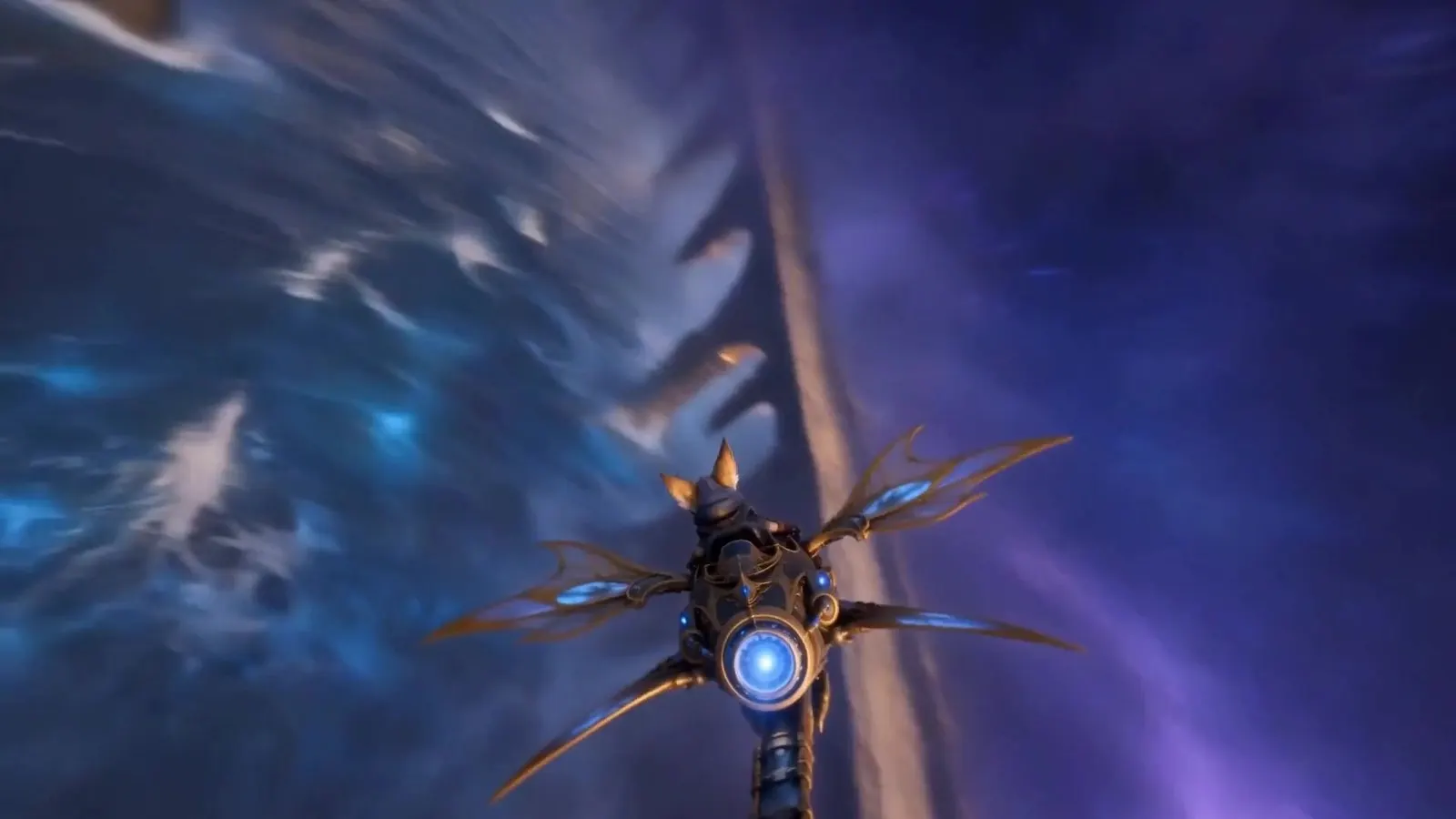
The one held image in the film. Everything before it is speed, everything after it is ground.
SCENE CONTEXT
Above the cloud, the glider crosses in front of a vast spiral in the sky, then rolls over and dives back down towards the water.

ACTIVE REFERENCES
@lyrian_v1: pilot upright, silhouetted. 100% matches the reference.
@skyrunner_v1: glider in silhouette with the core reading as the brightest point in frame.
@spires_v1: upper sky of the city, spiral galaxy, distant floating structures.

FIRST FRAME AND SPATIAL BLOCKING
Open with the spiral filling the upper two-thirds of frame and the glider entering from the lower left, crossing towards screen-right. The machine stays in the lower third and never covers the centre of the spiral.

OPTICS
35mm. A tighter field so the spiral holds its shape instead of bending at the frame edge.

CAMERA
Slow chase from slightly above, then a roll with the glider as it turns over into the dive.

ACTION TIMING
0:00 to 0:02 Level cross in front of the spiral, wings catching a rim of light.
0:02 to 0:03 The glider rolls inverted and pitches down.
0:03 to 0:04 Dive out of the cloud towards open water and cliffs below.

PHYSICS
The roll carries momentum through the turn. The rider stays fixed to the frame while the horizon rotates. Speed builds visibly in the dive.

LIGHTING
The spiral is the key light. Everything in the foreground goes to silhouette with a violet rim and one blue point at the nose.

AUDIO
Wind thinning at altitude, a low tone under the spiral, then air building in the dive.

POSITIVE CONSTRAINTS
One aircraft. The spiral stays behind the glider at all times. No extra light sources in frame.
E Touchdown 0:20 - 0:23
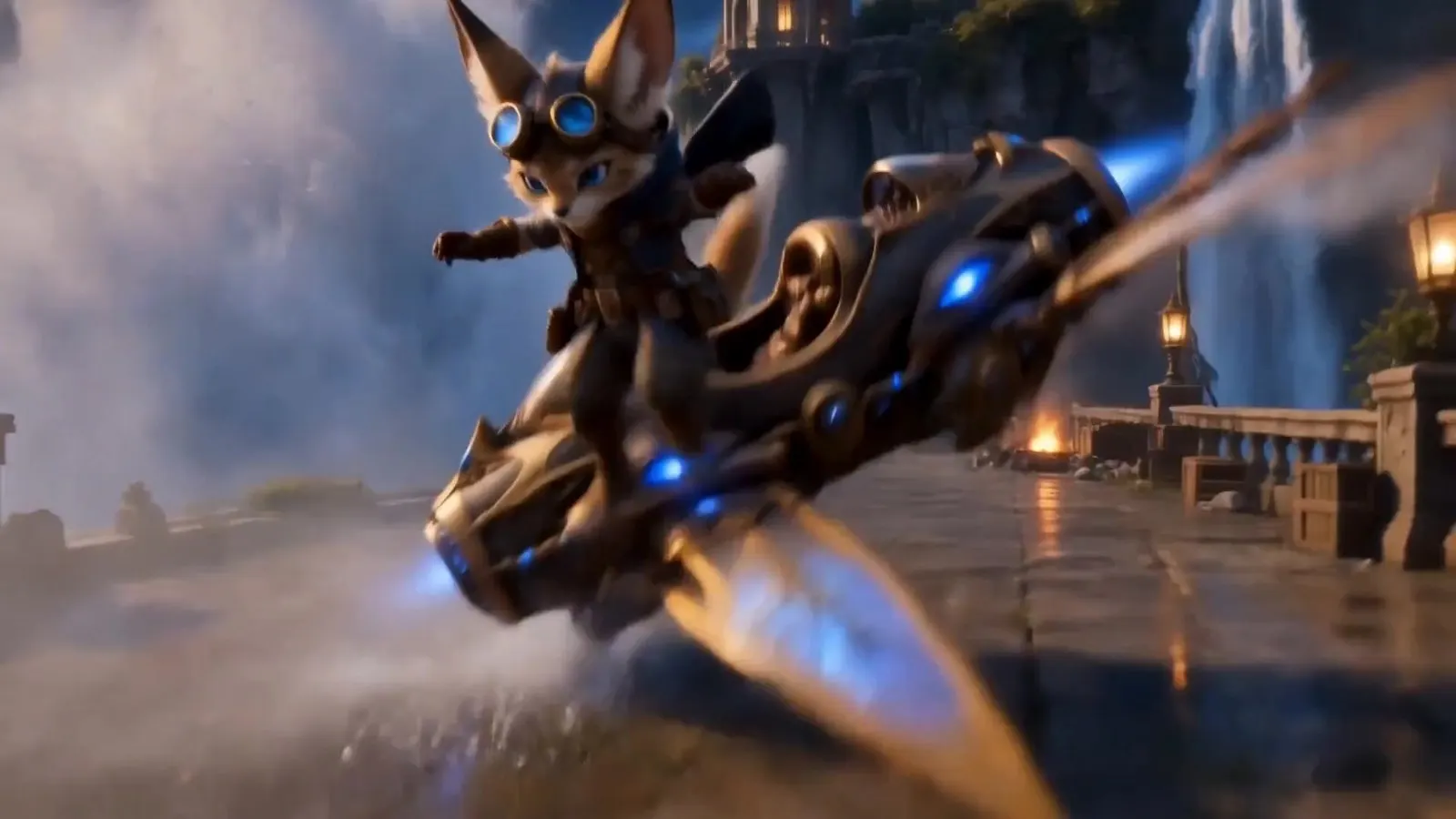
The reversal. A quiet approach becomes a loud arrival, and the machine that carried her now points at her.
SCENE CONTEXT
The glider comes in under a stone arch, skids along a wet terrace and the pilot steps off it already braced for a fight.

ACTIVE REFERENCES
@lyrian_v1: pilot dismounting, one hand still on the frame, knees bent. 100% matches the reference.
@skyrunner_v1: glider on the ground, wings still extended, core lit.
@enforcer_v1: 2.2m armoured enforcer, ceramic plate, silver mask, heat blade, standing at the far end of the terrace.
@spires_v1: stone terrace with balustrade, lanterns, crates, waterfalls and city beyond.

FIRST FRAME AND SPATIAL BLOCKING
Open low at deck height with the arch filling the upper frame and the glider coming through it towards camera. The terrace runs screen-left to screen-right. @lyrian_v1 lands at centre-left. @enforcer_v1 stands 8 metres away at centre-right, already turning towards her.

OPTICS
24mm at knee height. The low wide angle keeps the pilot small in the frame and the enforcer tall behind her.

CAMERA
Fast track in with the landing, then settle to a static low angle for the dismount.

ACTION TIMING
0:00 to 0:01 The glider passes under the arch, nose up, wings flaring.
0:01 to 0:02 It skids across wet stone with sparks and spray, turning side-on as it stops.
0:02 to 0:03 @lyrian_v1 swings off the frame and drops into a low crouch, facing screen-right.

ACTING TASK
She is counting what she has walked into. The eyes find the enforcer first, then the crates, then the exits, then back to the enforcer. The crouch is a decision to stay, not a landing pose.

PHYSICS
Weight transfers from machine to feet. Water sheets away from the skid. The glider keeps rocking slightly after it stops.

LIGHTING
Warm lantern light on the terrace, cold blue from the core beside her, pale sky behind the balustrade.

AUDIO
Metal on wet stone, wings settling, one heavy footstep answering.

POSITIVE CONSTRAINTS
Scale gap stays visible: the pilot reaches the enforcer's hip. Glider stays intact and stays in frame.
F The Terrace 0:23 - 0:30
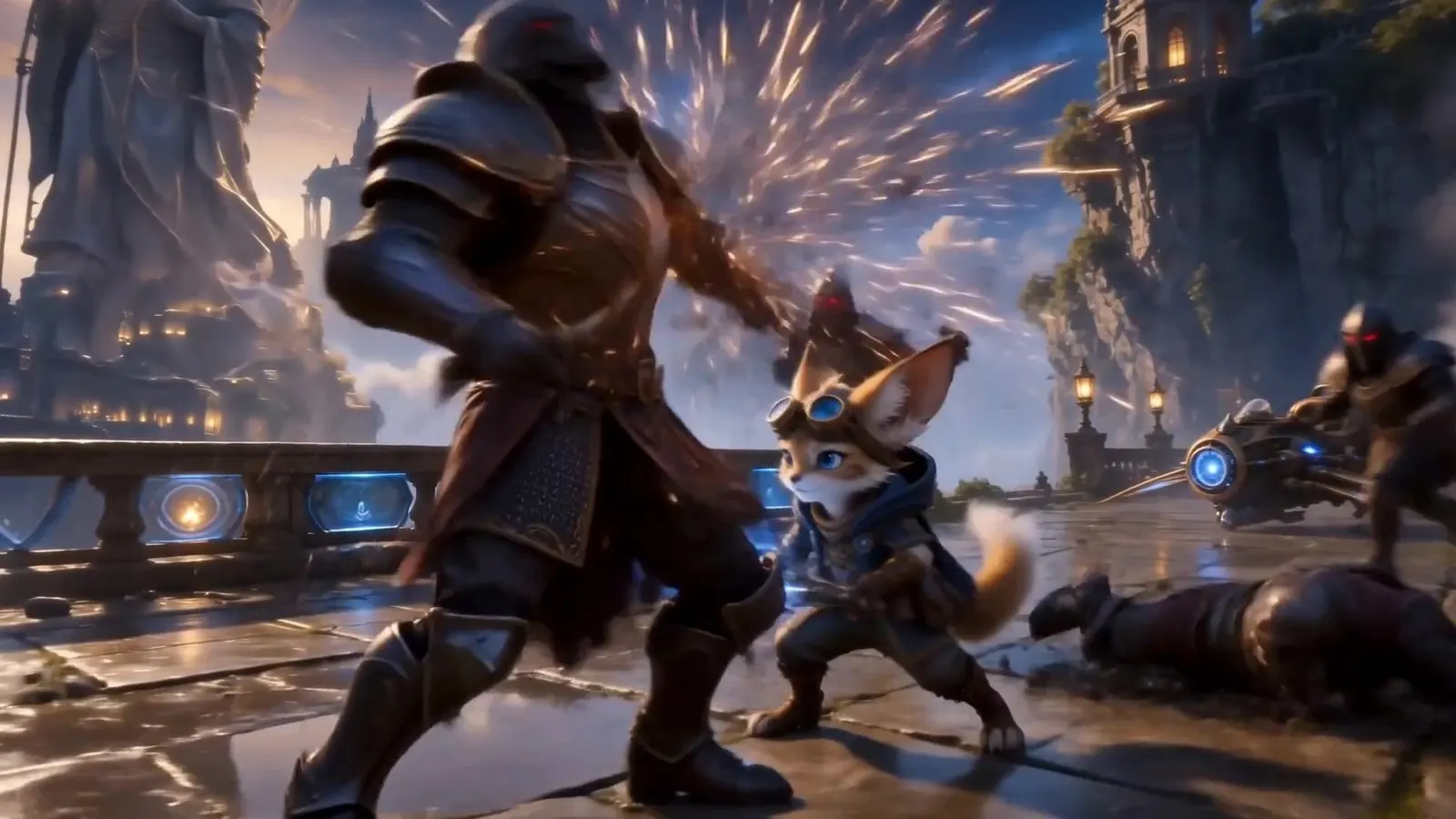
Ground fight in three passes. She never trades a straight hit, and the film ends before the outcome is decided.
SCENE CONTEXT
The pilot fights two enforcers across the terrace, staying inside their reach and using an arcane charge to put one of them down.

ACTIVE REFERENCES
@lyrian_v1: pilot fighting low and fast, blue arcane light gathered in the right hand. 100% matches the reference.
@enforcer_v1: two enforcers, ceramic plate armour, silver masks, heat blades. Both 2.2m.
@spires_v1: terrace, balustrade, lanterns, crates, city beyond.

FIRST FRAME AND SPATIAL BLOCKING
@lyrian_v1 holds the left half of frame throughout. The first enforcer attacks from screen-right, the second enters from behind him at 0:03. Neither enforcer crosses to the left of the pilot. The crates stay in the right foreground as a fixed landmark.

OPTICS
28mm at chest height for the exchanges, 40mm for the closing wide. Camera height stays low, so every frame reports the size difference.

CAMERA
Handheld with weight. It moves with her on each dodge and is knocked slightly on each blade impact.

ACTION TIMING
0:00 to 0:02 The first enforcer swings down. She rolls inside the arc and releases the charge into his chest, throwing him back.
0:02 to 0:04 HARD CUT. She vaults a crate as the second enforcer swings through it, splinters thrown across frame.
0:04 to 0:06 She lands screen-left, low, blue light building again in her hand.
0:06 to 0:07 Both settle facing each other across the terrace and hold to the final frame.

ACTING TASK
She is measuring reach and buying distance. After every exchange the eyes check the blade hand first and the feet second, and the breathing is working. He is trying to end it in one move and reads as slower each time he misses.

PHYSICS
Armour carries momentum and lands hard. Wood breaks along the grain. Wet stone gives under her feet on each turn. The charge throws light before it throws the body.

LIGHTING
Lantern warmth as the base, blue flash from the charge as a moment of key light, pale sky keeping the silhouettes readable.

AUDIO
Armour, splintering wood, one low concussive release, breathing.

POSITIVE CONSTRAINTS
Two enforcers only. Screen sides fixed. The final frame is static with all three figures in shot.
The look
What was asked for every time, so that 6 blocks read as one film.
- Animation style
- Painterly fantasy realism. Rendered volumes, soft edges, visible brush character in the architecture and cloud.Motion blur is allowed on the flight and pulled back on the ground fight so impacts stay readable.The rider animates against the machine: she leans before it banks, and she settles after it stops.
- Palette
- Warm brass and stone against cold blue arcane light. Violet is held back for the sky and the vortex.The glider core is the brightest point in almost every frame and works as the eye anchor through the cuts.Enforcer armour stays desaturated so the blue charge reads against it.
- Camera grammar
- Flight is chase camera at a stated distance and height. Ground work is handheld at knee to chest level.Travel runs screen-left to screen-right for the whole flight, which is what lets five blocks cut as one run.Every low angle on the terrace is there to report the size difference between the two fighters.
- Scale
- The pilot is 92cm and the enforcers are 220cm, and no frame is allowed to forget it.Architecture is framed with a human-sized element in shot so the city keeps its size.The glider stays 1.8m long against every landmark it passes.
The city only feels enormous while something small is flying through it.
Locks and quality control
The failure modes that cost generations, and the instruction that closed each one.
-
Direction flipping
Symptom The glider reversed its travel direction between blocks, which broke the run into unrelated shots.
Lock The drawn route attached as a position reference to every flight block, plus one written line fixing travel from screen-left to screen-right.
-
Scale collapse
Symptom The pilot grew towards human height whenever she was framed alone with the machine.
Lock Height stated in numbers for both characters, and a landmark of known size kept in frame on every wide.
-
Rider and machine drift
Symptom The rider and the glider were treated as two unrelated references and stopped matching.
Lock Both designed on a single sheet and described together in one anchor line, with the seated position named.
-
Style bleed from the map
Symptom The route drawing tried to enter the shot as a graphic look.
Lock The route reference attached last and described in positive terms only, with style ownership handed to the city plate and the character sheets.
-
Mushy impacts
Symptom Blade hits and landings read soft, with everything moving at the same weight.
Lock Physics written per block: what carries momentum, what breaks, what gives underfoot, and in which order the weight lands.
-
Empty first frame
Symptom Flight blocks opened on scenery and lost a second before the machine appeared.
Lock First frame occupancy stated at the top of the blocking section. The glider is in shot and already moving at 0:00.
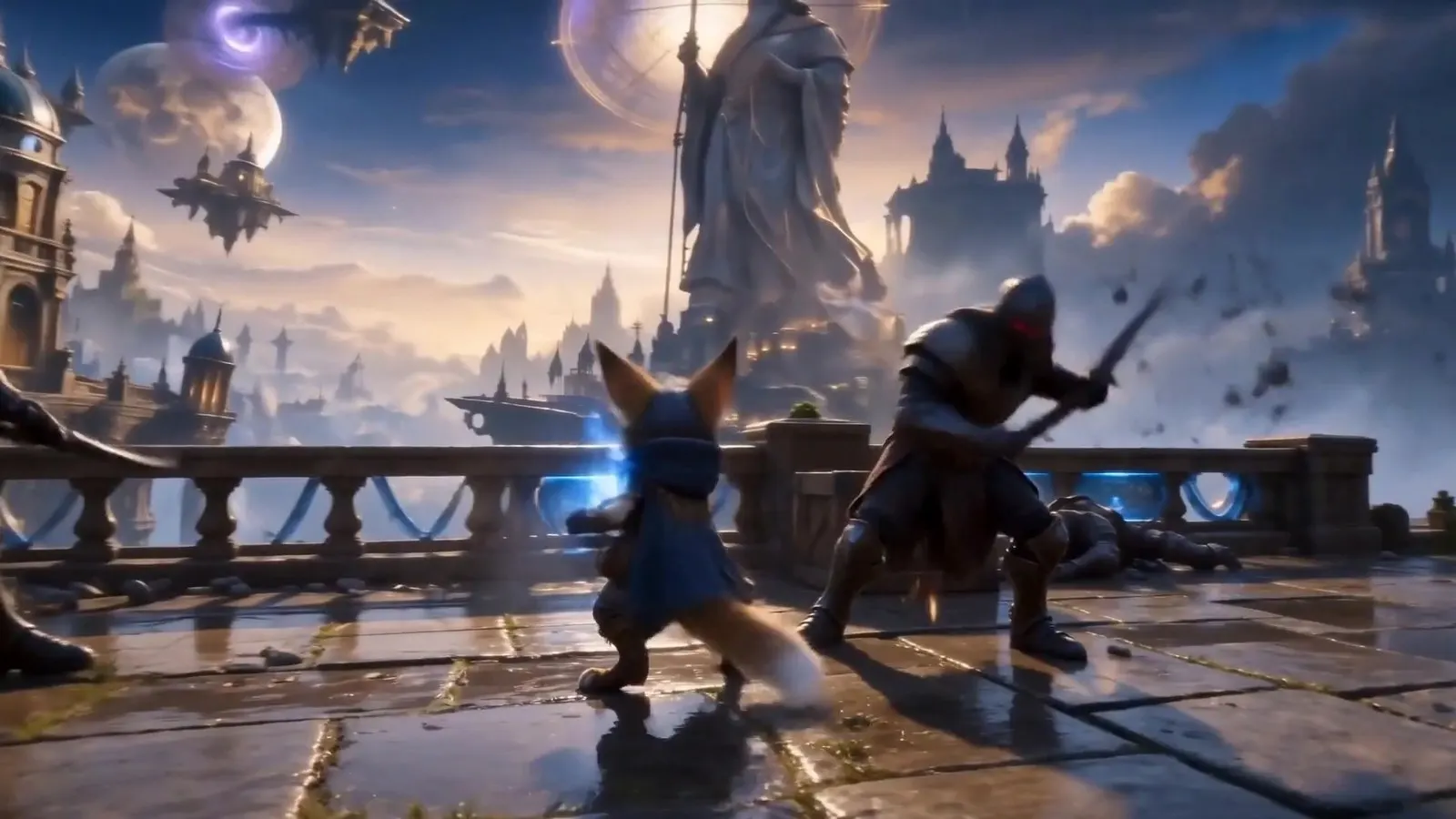
Skyrunner, the process document
Eleven wide-format sheets covering the whole build. The story spine and the beat map, the three design plates and the scale gap they lock, the hand-drawn route and how it is written into a prompt, the nine pipeline stages, the stack, all six shot prompts as written for Seedance, the look rules that hold six blocks together, and the six failure modes with the instruction that closed each one.

This document is a set of eleven wide-format sheets. On a small screen it reads better opened on its own.