Original short 1:47
Mars Drop
Two men, one red planet, and the growing suspicion that somebody is testing something.
A chef and a rocket executive find themselves standing on a Mars colony with no memory of getting there. Over a hundred and seven seconds they stop arguing about whose fault it is, work out that they are inside a demonstration, and start giving notes to the person running it.
- Runtime
- 1:47
- Format
- 1920 x 1080 / 24 fps / 16:9
- Structure
- 4 beats, one location, two characters
- Episodic engine
- Showrunner
- Design
- Nano Banana 2, ChatGPT Image 2
- Motion
- Higgsfield
- Voice
- ElevenLabs
The film
The spine was beaten out with the tig-scene-engine skill before a single frame was generated. A short cut still needs a chain, otherwise it is only a reel of pretty motion.
- Want
- Both men want an explanation for why they are standing on Mars.
- Obstacle
- There is no explanation available to them inside the scene.
- Turn
- They stop asking each other and start addressing the thing watching them.
- Cost
- Admitting they are a demo, which is also the only way out.
- Last image
- The wide it opened on, with one of them asking for a snack.
Every other film we publish leans on movement. This one deliberately has none: no chase, no weather, no creature, nothing for a viewer to look at while the performances settle. If the two of them are not listening to each other, there is nothing on screen to cover it, which is the whole reason the piece exists.
- Runtime
- 1:47
- Master
- 1920 x 1080, 24 fps, H.264
- Sound
- Two cloned reads, mixed against room tone in the edit
- Subtitles
- Burned in, speaker-labelled, because two voices in one wide need attributing
- Cut for
- Wide only. There is no vertical version and there should not be
Beat map
4 generation blocks, cut internally where the model was asked for a hard cut.
Cast and world
Two figures, both caricatures, both invented for this piece. Neither is presented as a real person and nothing either of them says is attributed to anyone.
-
THE CHEF
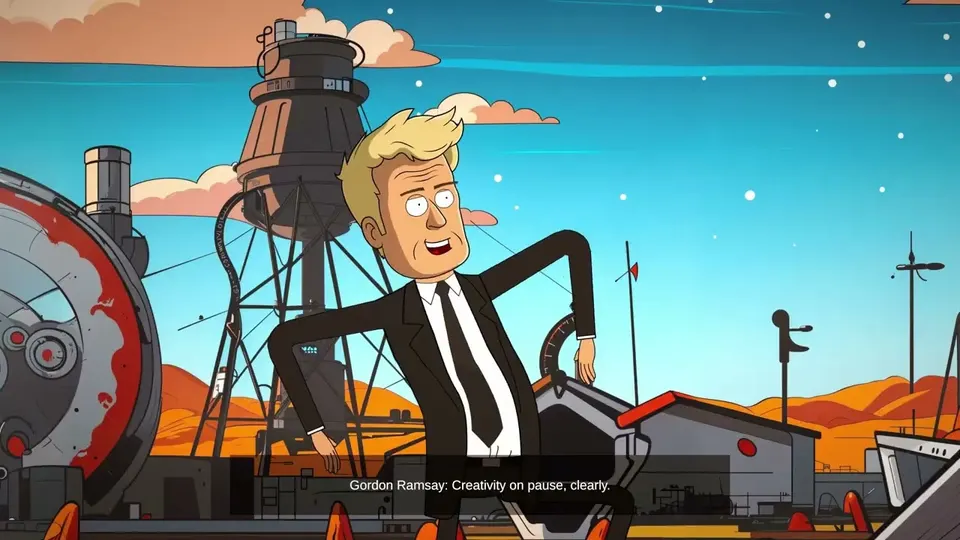
Black suit, tie, blond sweep
-
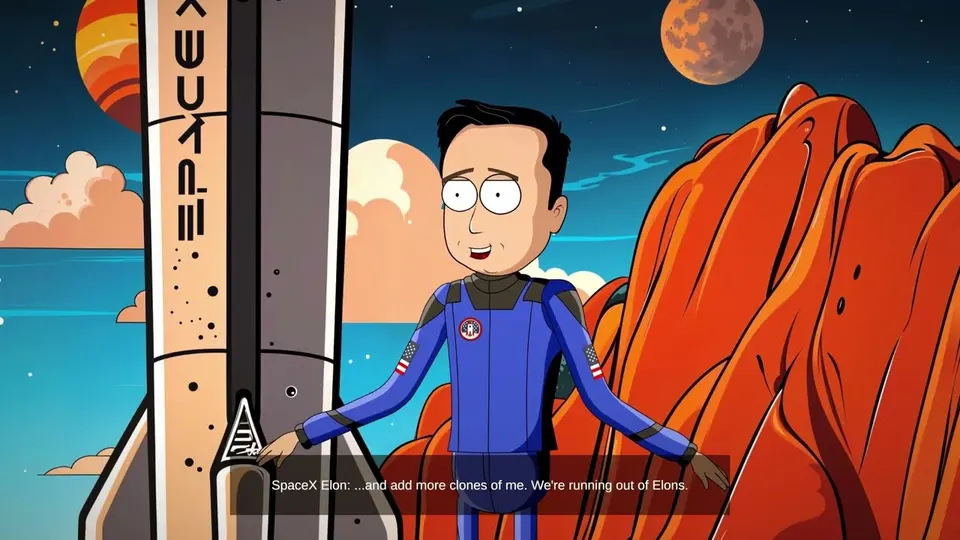
THE EXECUTIVE
Navy flight suit, mission patch
-
THE COLONY
One location, three angles
The designs are broad on purpose. A caricature survives a shot-size change that a rendered likeness does not, and it removes any question about whose face is on screen. Both were locked as reference sheets before the first shot and neither was re-described in a prompt after that.
Pipeline
From beat sheet to graded cut, inside one chat window.
-
01
Write the scene
Written first, in full
All eleven exchanges, in order, before anything rendered. A dialogue scene assembled from whatever the model happened to produce is a montage with subtitles.
-
02
Fix the beats
Four blocks
Arrival, act natural, the demonstration and the notes. Each beat keeps one camera position. The beat map fixes the cutting pattern.
-
03
Lock the two designs
Nano Banana 2, ChatGPT Image 2
Reference sheets for both figures and for the colony, generated and approved before any shot. Nothing after this stage describes a character in words.
-
04
Build the scene
Showrunner
The episodic engine carries the scene and the character continuity across shots. This is the stage that makes a two-hander possible at all: the same two figures, in the same place, across four beats.
-
05
Performance pass
Higgsfield
Motion on each block follows the listener. The reaction comes first and the line is timed to it.
-
06
Voice
ElevenLabs
Two reads, cut against picture. Both were retimed after the motion pass because a line arriving on the gesture reads as a puppet.
-
07
Assembly
CapCut
Cut, room tone, and burned-in speaker-labelled subtitles. Two voices in one wide need attributing or the audience spends the first exchange working out who is who.
Seven stages and only two of them are generation. That ratio is the finding: on a piece with no action in it, the work moves out of the render and into the writing, the casting and the timing, which is where it sits on a live-action two-hander as well.
The stack
Four tools, three custom skills, one operator.
-
Showrunner
Episodic engine
Holds the scene and the two characters across four beats. The reason this is a scene and not four clips.
-
Nano Banana 2
Design
Character sheets and the colony plates, locked before the first shot.
-
ChatGPT Image 2
Design
Set dressing and the second pass on the habitat and tower.
-
Higgsfield
Motion
The performance passes. Directed at the listener, not the speaker.
-
ElevenLabs
Voice
Both reads, retimed against the finished motion.
-
CapCut
Assembly
Cut, mix and burned-in subtitles.
Custom Claude skills
-
tig-scene-engine
Structure
Goal, obstacle, tactic, reversal, value shift, applied to a scene with no plot in it. The reversal is the two of them turning to face the camera.
-
tig-acting-task
Performance
The acting task per beat, written for the listener as well as the speaker. Every note in the film about looking like a malfunctioning robot came out of failing this first.
-
cinedance
Blocking
Three camera positions, fixed, with the two figures held on their sides of the set so a cut between singles never crosses the line.
No video model appears in this stack at the shot level, which is the difference between this workflow and the other two. Twin Moons and Skyrunner are built shot by shot out of a video model. This one is built scene by scene out of an episodic engine, and the trade is the one you would expect: continuity comes free, spectacle does not.
Shot sheets
One block per generation, each with the still it produced and the prompt that made it, as written for Seedance 2.0 and built with the cinedance skill. Every prompt is here in full.
A Arrival 0:00 – 0:26
The wide is held longer than is comfortable. Both men are in it, neither is centred, and the joke lands before either has moved.
Wide establishing shot, flat 2D animation, thick ink outlines and flat colour fills. A Mars colony floor in mid-afternoon light: a landed white booster on a four-legged pad right of frame, a silver geodesic habitat and lattice antenna masts left of frame, layered orange rock formations across the background, a small second moon high in a blue sky. Two figures stand about four metres apart on the dust, both full length, both small in frame. Camera locked off at eye level. No camera move.
B Act natural 0:26 – 0:52
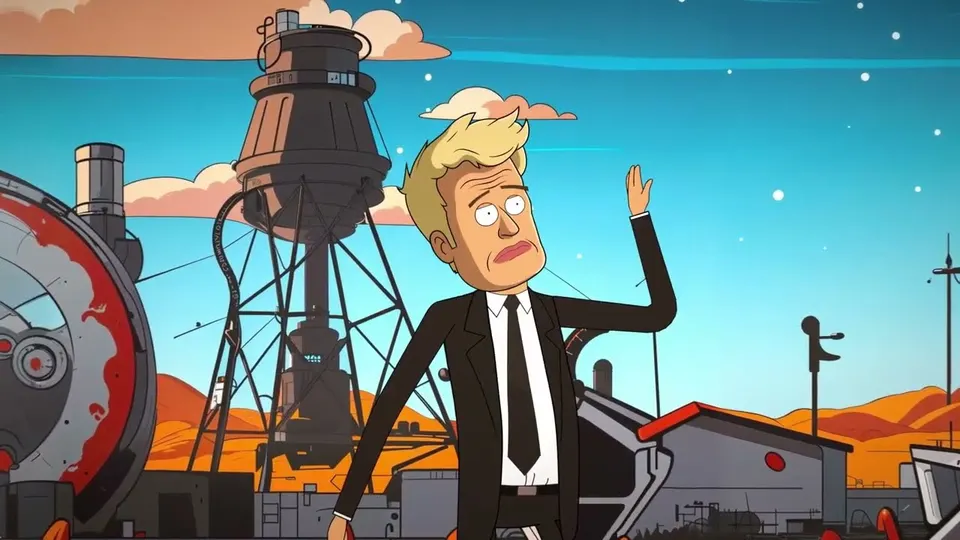
The first single. The line is an instruction to the other man and a piece of direction to the film at the same time.
Medium single, same flat 2D animation register. A tall man in a black suit, white shirt and black tie, blond hair swept up, standing in front of a dark steel water tower on lattice legs. Orange dunes and a signal mast behind him, cyan sky with scattered stars. He raises one hand shoulder height, palm out, eyes wide, mouth open mid-word. Slight breathing motion only. Camera static, eye level, subject centre-right.
C The demonstration 0:52 – 1:20
The turn. He works out what they are in, and the shrug lands one beat ahead of the line.
Medium single, reverse of the previous angle, same register. A man in a navy-blue flight suit with shoulder flags and a round mission patch, dark hair, standing beside the lower stage of a white booster with vertical lettering down it. A deep orange rock wall fills the right third of frame, two moons in a dark blue sky, pale cloud bank low behind him. He opens both arms in a shrug, palms up, shoulders lifting. Camera static, eye level, subject centre.
D Notes to the operator 1:20 – 1:47
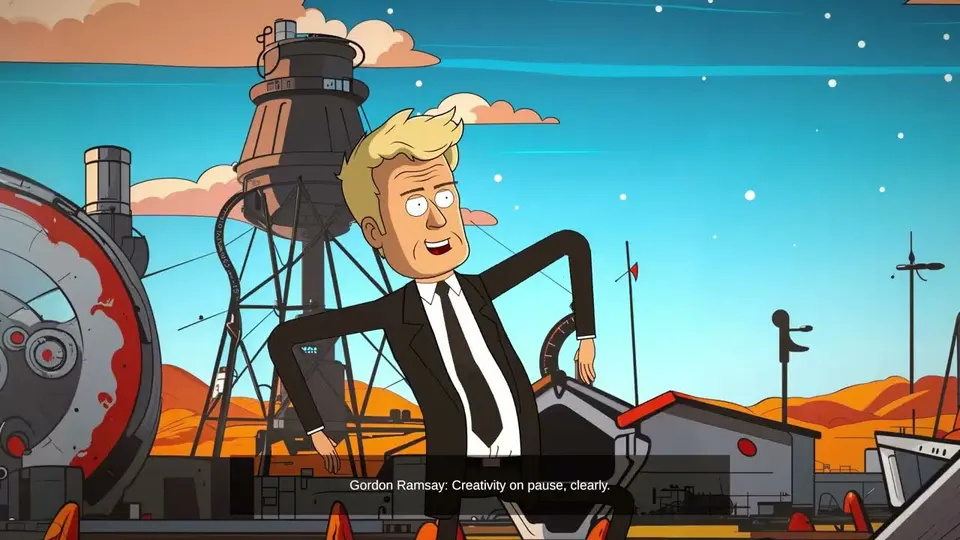
The address to camera, then straight back to the opening wide so the film ends where it started, with nothing resolved.
Medium single, same setup as beat B. The man in the black suit plants both hands on his hips and leans a few degrees toward camera, chin lifted, with his eyeline fixed just off lens. Water tower and orange dunes behind, unchanged. Hold, then cut to the beat A wide, identical framing, both figures back in position.
The look
What was asked for every time, so that 4 blocks read as one film.
- Register
- Flat 2D, thick ink outline, flat colour fill. No gradients on character art.Backgrounds carry the texture; the figures never do.
- Colour
- Orange rock, cyan sky, one cool blue costume against one black suit.The two figures are the only saturated cool notes in frame, so they separate from the set at any distance.
- Camera
- Three positions total: the wide, the tower single, the booster single.Locked off. No push, no drift, no handheld. A moving camera in a two-hander is a way of hiding that nothing is happening.
The look rules exist to stop the piece reaching for coverage it does not need. Every temptation on a scene like this is to add a shot, and every added shot is another place for the two designs to drift.
Locks and quality control
The failure modes that cost generations, and the instruction that closed each one.
-
Dead listener
Symptom The character not speaking froze into a held pose for the length of the other man’s line.
Lock The reaction is generated before the line, and the line is timed to it. If the listener is idling, the beat goes back regardless of how the delivery reads.
-
Shot-size drift
Symptom Both figures lost proportion between the wide and the singles: heads grew, the jawline moved.
Lock Two reference sheets, fixed at stage 03, and no verbal description of either character in any prompt after that.
-
Line-crossing
Symptom Cutting between the two singles put both men facing the same way, so the conversation stopped reading as a conversation.
Lock Camera positions fixed to three, each one assigned a side. The tower single looks camera-right, the booster single looks camera-left, and nothing else is shot.
-
Voice ahead of gesture
Symptom Lines landed on the movement, which made the characters read as lip-synced puppets.
Lock Voice is cut last against picture, with every read timed after the motion pass.